- BT Community
- /
- Broadband
- /
- BT Fibre broadband
- /
- Re: Issues with changing to FTTP
- Subscribe to this Topic's RSS Feed
- Mark Topic as New
- Mark Topic as Read
- Float this Topic for Current User
- Bookmark
- Subscribe
- Printer Friendly Page

- Mark as New
- Bookmark
- Subscribe
- Subscribe to this message's RSS Feed
- Highlight this Message
- Report Inappropriate Content
Issues with changing to FTTP
I've received an unexpected SMS from BT thanking me for 'my order' (what order?) and setting an appointment for OpenReach to do some work at my house (what work?). After a lot of searching it would appear that the intention is to switch me to DV and upgrade my copper landline to FTTP at the same time. The change to DV is unwelcome for various reasons, but nothing I can do about it long-term. Apparently the upgrade to FTTP will be at 'no extra cost', so welcome in part but....it leaves a lot of unanswered questions.
My current master socket is downstairs at the front of the house in the hall with our main phone, with dedicated extension cabling to a socket for the router upstairs at the back of the house in our 'office'. The router has to stay there as all the IT kit has wired Ethernet to that location. The original plan for DV had made no mention of changing to FTTP, so the intention had been to use the existing cabling with an Adaptor to support the phone in the hall.
1. What are the dimensions of an ONT and how much space do you need around it for cabling?
2. The BT info shows a BBU next to the ONT. Is that the same as the one intended for the router, or a separate one just for the ONT? How big is that BBU?
BT seems to assume that the router and ONT are co-located - I've got no room to do that. Also they require a free double-socket - my socket supports the master phone (and in due course it will need to do the Adaptor as well).
As an aside.....what I find really annoying is that I've just spent £££££ refurbishing my hall with a new floor, drywall insulation and complete redecoration. Had there been proper planning of this work, I could have made provisions for the extra power sockets and cable conduit as part of the work. Now I have to postpone the fitting of new built-in storage until I know exactly what is going where 😞 The sensible approach IMHO would be a pre-installation site inspection to determine (a) what can go where and (b) what, if anything, the customer can do in preparation beforehand.

 imjolly
- Mark as New
- Bookmark
- Subscribe
- Subscribe to this message's RSS Feed
- Highlight this Message
- Report Inappropriate Content
Re: Issues with changing to FTTP
the ONT is about 9cm square as shown here
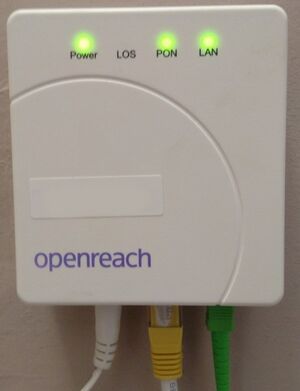
there is no longer a BBU supplied only the ONT
you can discuss the installation with openreach on arrival and if you are not happy then decline the installation of FTTP
If you like a post, or want to say thanks for a helpful answer, please click on the Ratings 'Thumbs up' on left hand side.
If someone answers your question correctly please let other members know by clicking on ’Mark as Accepted Solution’.
 licquorice
- Mark as New
- Bookmark
- Subscribe
- Subscribe to this message's RSS Feed
- Highlight this Message
- Report Inappropriate Content
Re: Issues with changing to FTTP
The ONT and hub don't need to be co-located but you will have to run the Ethernet cable ( up to 100 metres) between them yourself if they are not.
- Mark as New
- Bookmark
- Subscribe
- Subscribe to this message's RSS Feed
- Highlight this Message
- Report Inappropriate Content
Re: Issues with changing to FTTP
If the ONT needs power in order to function, but no longer comes with a BBU, then how does the FTTP continue to function in the event of a power-cut please?
Does the ONT have to be immediately the other side of the wall from the outside junction box, so that the inter-connecting cable merely comes straight thru' the wall, or can the cable from the JB come inside and then run down/along the inside wall before going into the ONT?
If BT are going to upgrade me to FTTP without extra charge, then I'm happy to go down that route for future-proofing. What concerns me is struggling to work how where exactly to put the ONT so that it can be most easily connected to the router and power. I would much rather get the details clarified now, rather than wait until OR turn up, then say 'that's not an acceptable solution so don't do that', only to find downstream that the copper landline is permanently disconnected at some later date and I have to pay for the upgrade to FTTP.
licquorice
- Mark as New
- Bookmark
- Subscribe
- Subscribe to this message's RSS Feed
- Highlight this Message
- Report Inappropriate Content
Re: Issues with changing to FTTP
As your hub doesn't currently work in a power cut, it is academic if the ONT no longer works either.
If you wish both to work, it will be necessary to invest in a UPS.
The fibre doesn't need to directly enter the rear of the ONT, it can be run internally for a certain distance.
- Mark as New
- Bookmark
- Subscribe
- Subscribe to this message's RSS Feed
- Highlight this Message
- Report Inappropriate Content
Re: Issues with changing to FTTP
But according to all the BT publicity, they supply a BBU for the router. So have they stopped doing that then?
Having to buy a UPS could be quite expensive, given that the router and ONT will be in different places and so need one each.

- Mark as New
- Bookmark
- Subscribe
- Subscribe to this message's RSS Feed
- Highlight this Message
- Report Inappropriate Content
Re: Issues with changing to FTTP
BT don’t supply a BBU/UPS except in cases where the customer is considered to be vulnerable, as far as expense , that’s relative, they can be had for a relatively small amount ( around £50 -£60 ) what’s more it’s only telephony that’s deemed to be ‘important’ insofar that efforts need to made to maintain it , in the majority of cases that’s the customers own (existing) mobile phone and the ISP advising them to keep it charged , and of course if the particular BT customer is broadband only , the lack of telephone in a power outage is moot , that customer has already decided themselves that ‘landline’ telephone isn’t important.
If your broadband is so import (to yourself ) and you live somewhere where the DNO ( power company) fail to keep your power supply reliable, and you are subject to frequent power outages , it begs the question what do you do now when your router loses power ?
If your argument is if you get an ONT it needs to have a BBU because you don’t have a mobile , presumably it’s worth the cost (whatever that may be )to supply yourself with a way to keep the ONT ( and router) powered during a mains power outage , although you currently seem relaxed about your router not being powered during the presumably frequent power outages otherwise this is a bit of a non issue and losing power no more frequent and disruptive as you losing your current copper pair service due to a line failure.

- Mark as New
- Bookmark
- Subscribe
- Subscribe to this message's RSS Feed
- Highlight this Message
- Report Inappropriate Content
Re: Issues with changing to FTTP
I agree that this would indeed by a sensible approach and could save Openreach a lot of wasted time when they show up and find issues with a FTTP installation.
I tempted to say "Openreach don't do sensible" but maybe that's a little harsh?
- Mark as New
- Bookmark
- Subscribe
- Subscribe to this message's RSS Feed
- Highlight this Message
- Report Inappropriate Content
Re: Issues with changing to FTTP
You can indeed do this, but there have been a number of cases where BT has nevertheless gone ahead and discontinued the FTTC broadband service, assuming that the FTTP installation has been successful. Thus leaving the customer with no broadband at all for a period while this muddle is sorted out
BT-Openreach communication is often not very good.
- Mark as New
- Bookmark
- Subscribe
- Subscribe to this message's RSS Feed
- Highlight this Message
- Report Inappropriate Content
Re: Issues with changing to FTTP
Without risking fate, generally the power supply in my area is good, but there are the occasional failure - like when the underground cable in our road blew out a couple of months ago and we were without power for almost a day. Now admittedly a BBU would be dead long before then, but at least the chance to make a few urgent calls initially would be useful. Mobile signal is erratic in and around out house at best, so I would not wish to rely solely on that. As we are on BT's 'vulnerable customers' list, then I would expect them to make at least some effort to live up to their hype about supporting us.
My main gripe/concern is the way that this upgrade has been 'imposed' on us without prior consultation or the provision of detailed guidance as to the nature of the equipment to be supplied. Most of their publicity seems to be based on the bland assumption that Openreach can simply turn up and say "we've come to do this" and the householder will simply say "fine, carry on" and not be too bothered about that they do.
As it happens, I spent the last 15-odd years of a long IT career designing and supervising fibre-optic networks in a variety of challenging environments, so I can appreciate many of the issues. The one thing that we would never have done would be to turn up on 'on the day' and just say "right, where do you want this fitted?" There would have been a site visit, complete with samples of the kit, an examination of the various options, discussions about potential extra power-cokcets etc, and an eventual decision that would be supported by a copy of the design plan and a signed agreement. That way the customer would know exactly what to expect (hopefully) without any last-minute surprises. Probably all too much (expensive) work for Openreach...but they forget that it is not the customer who is asking for it.
Anyway, that's my 'rant for the day' 🙂 The information gleaned so far has been useful and I'm starting to get a better idea of how I might get this to work eventually.
